
Growth in Intra-Emerging Markets Trade


The trend towards greater trade between emerging market (EM) countries provides a positive outlook for the long-term benefits of investing in emerging markets. This intra-EM trading activity – which bypasses developed countries – offers a route to more self-sustaining growth and accompanies a process where emerging markets are diversifying supply chains to derisk and recognising ballooning consumer appetites in regions where income levels are rising and urban development is rapid.
Intra-EM trade now also accounts for nearly half of total EM trade and is strategically positioned to serve these new consumer markets. This evolving architecture has the potential to enhance the resilience and autonomy of countries engaging in it, signalling a positive structural shift for investors. Additionally, trade between developing economies accounted for 24% of total global trade in 2023, and this ‘South-South’ trade grew faster than trade between developed economies, despite shrinking trade surpluses and weakening foreign direct investment.
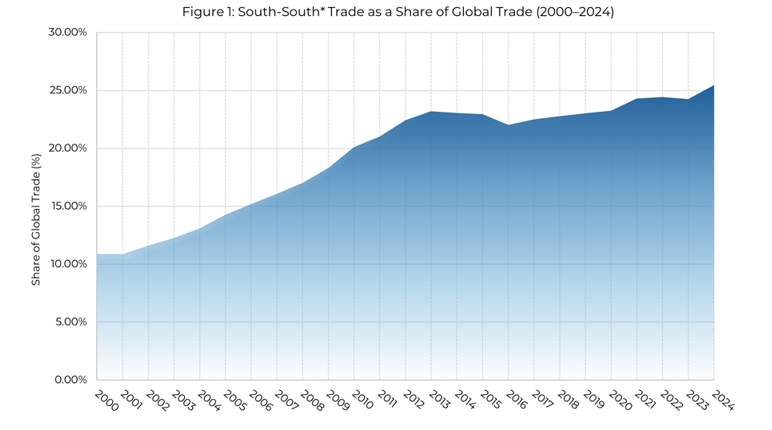
*South-South denotes developing country to developing country
Source: Guinness Global Investors; UNCTAD Datacentre
India, China and Brazil: Emblems of EM-to-EM trade
This deepening of intra-EM trade connections is evident in some of the largest EM economies. China and India, keen to diversify their trade partnerships and cement their positions as alternative leaders of the Global South, have pursued Brazil as the gateway to the rest of Latin America. As the largest economy in the region, Brazil has the consumption capacity to be an invaluable partner for EM-to-EM trade. Its established regional partnerships can also act as a point of confidence for other countries pursuing similar bilateral relations.
China’s expanding automotive trade in Brazil
Government promotion of electric vehicles (EVs) to achieve environmental and sustainability goals has made Brazil the newest frontier for China’s EV boom, with Chinese brands capturing more than 80% of all EV sales in Brazil in 2025. In fact, in August, Chinese-made cars represented a remarkable 32% of Brazil’s total imports.
Like in many industries Chinese companies compete in, pricing has been a major draw. Automotive giant BYD offers its Dolphin Mini starting at around $22,000, which is $7,000 less than General Motors’ cheapest comparable model in Brazil. This can make China’s deepening export relationship with Brazil a double-edged sword, as competitively priced Chinese models can compete with local automotive production.
Brazilian exports this year have shown strong growth driven by the Mercosur agreement, which minimises restrictions of movement between Latin American economies, and cautious economic rebuilding in Argentina (Brazil’s main export recipient), which has increased consumer demand. However, the Brazilian automotive industry’s future success depends on its ability to maintain Argentine demand, as well as that from other Latin American economies, in the face of cheap Chinese EV models.
The challenge looking forward will be how Brazil balances development with China without falling into a dependency trap or undermining its own industrial upgrading by remaining a primary goods exporter. Brazil and other Latin American countries could even emerge as strategic players in the EV revolution.
India’s deepening relationship with Brazil
It is equally worth noting the budding relationship between India and Brazil. As of September 2025, India accounted for roughly $404m of Brazil’s exports, while Brazil is India’s largest upstream investment destination in the Americas (and India’s third globally).
The two countries have since agreed to deepen economic engagement by expanding their Preferential Trade Agreement within the Mercosur framework, setting a new bilateral trade target of $20bn by 2030. Indian investment will span clean energy, the automotive sector, agriculture and semiconductors, while Brazil has expressed interest in collaborating on sensitive areas such as data protection, 5G networks and quantum technology.
Intra-EM trade puts emerging markets’ destiny in their hands
These structural changes should encourage investors to reassess long-held assumptions about emerging markets. The path of global trade flows is shifting away from established trade relationships, with EM states able to build supply chains that bypass developed countries entirely. Furthermore, the deepening of intra-regional trade increasingly provides a degree of insulation from external shocks such as America’s wide-ranging ‘Liberation Day’ tariffs of April 2025.
Across all these regions, a key factor behind deepening EM intra-regional trade is the rapidly growing consumer market, driven by increased populations and growing incomes. Read how these demographic changes are driving another reason to give your portfolio exposure to Emerging Markets here.
Risk: The Guinness Emerging Markets Equity Income Fund is an equity fund. Investors should be willing and able to assume the risks of equity investing. The value of an investment and the income from it can fall as well as rise as a result of market and currency movement; you may not get back the amount originally invested. The Funds are actively managed with the MSCI Emerging Markets Index used as a comparator benchmark only.
Disclaimer: This insight may provide information about Fund portfolios, including recent activity and performance and may contains facts relating to equity markets and our own interpretation. Any investment decision should take account of the subjectivity of the comments contained in this insight. This insight is provided for information only and all the information contained in it is believed to be reliable but may be inaccurate or incomplete; any opinions stated are honestly held at the time of writing but are not guaranteed. The contents of this insight should not therefore be relied upon. It should not be taken as a recommendation to make an investment in the Funds or to buy or sell individual securities, nor does it constitute an offer for sale.