
Sustainable
Reflecting on 2024: Strengthening stewardship and engagement for a sustainable future
By Rachael Monteiro

A review of WHEB's 2024 stewardship work, covering net zero targets across portfolio emissions, diversity engagement and proxy voting.
This insight was originally produced by WHEB Asset Management, now part of Guinness Global Investors.
With 2024 now behind us, we reflect on WHEB’s Stewardship and Engagement efforts - celebrating accomplishments, learning from challenges, and identifying opportunities for 2025.
This year, our stewardship activities spanned a range of impactful initiatives, including direct engagements with portfolio companies, both individually and through collaborative investor coalitions, active participation in voting at company AGMs, and policy advocacy to drive systemic change. Below we share updates on this work from the last year.
1. Climate Action
Our focus remained on encouraging portfolio companies to adopt science-based net zero carbon (NZC) targets, particularly those validated by the Science Based Targets initiative (SBTi) ¹.
Setting such targets is a critical precursor to achieving meaningful emissions reductions. They also align with our own commitments to have 85% of financed emissions covered by NZC targets by 2025 and 100% by 2028².
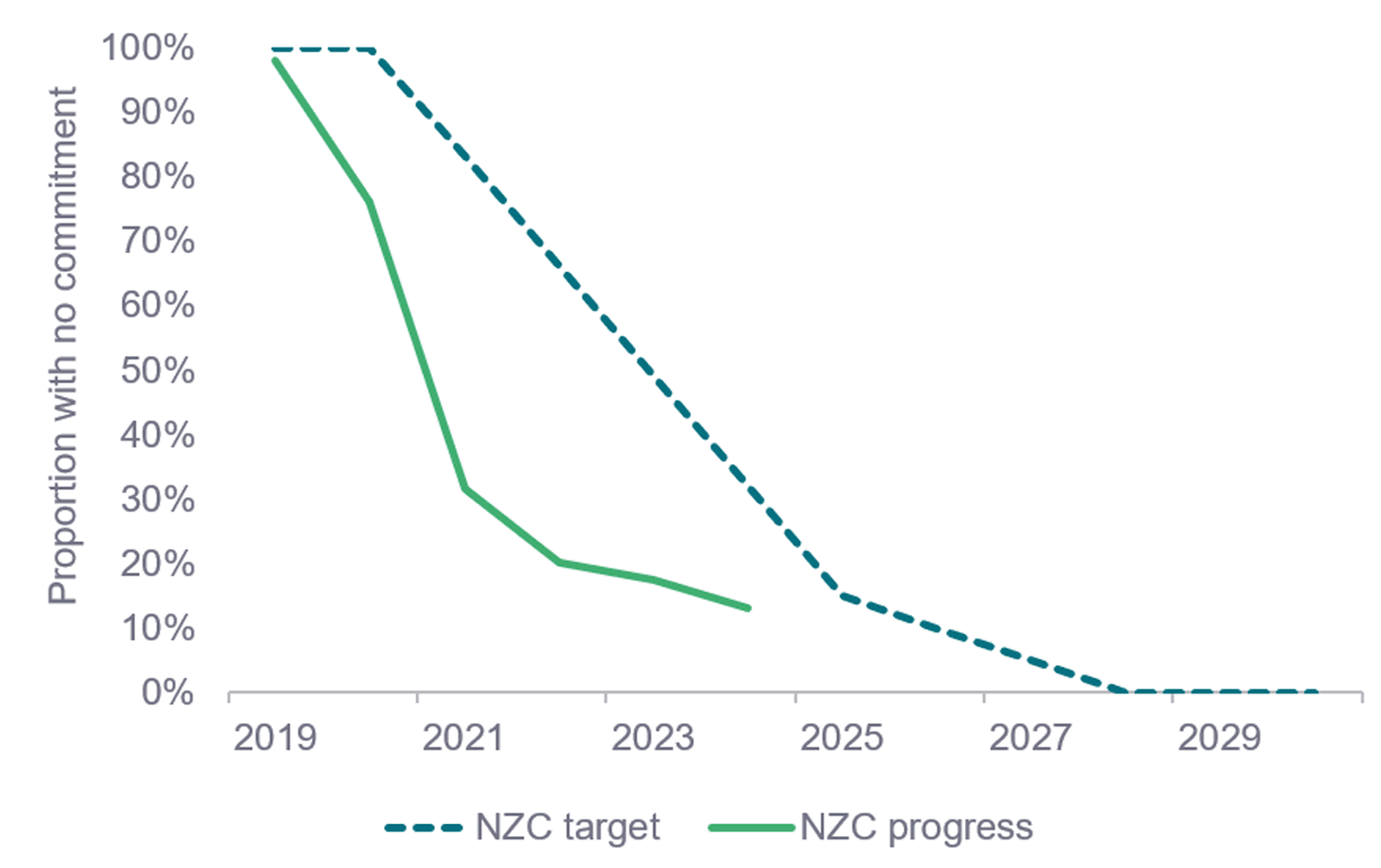
As of 2024, 87%³of the portfolio’s financed emissions are covered by NZC targets. 77% of the financed emissions are covered by SBTi-validated targets, rising to 90% when including companies that have committed to setting such targets, positioning us well to meet our commitment by the end of this year (Figure 1).
Figure 1: WHEB’s portfolio is on track to meet 2025 and 2028 commitments to proportion of financed emissions covered by NZC targets
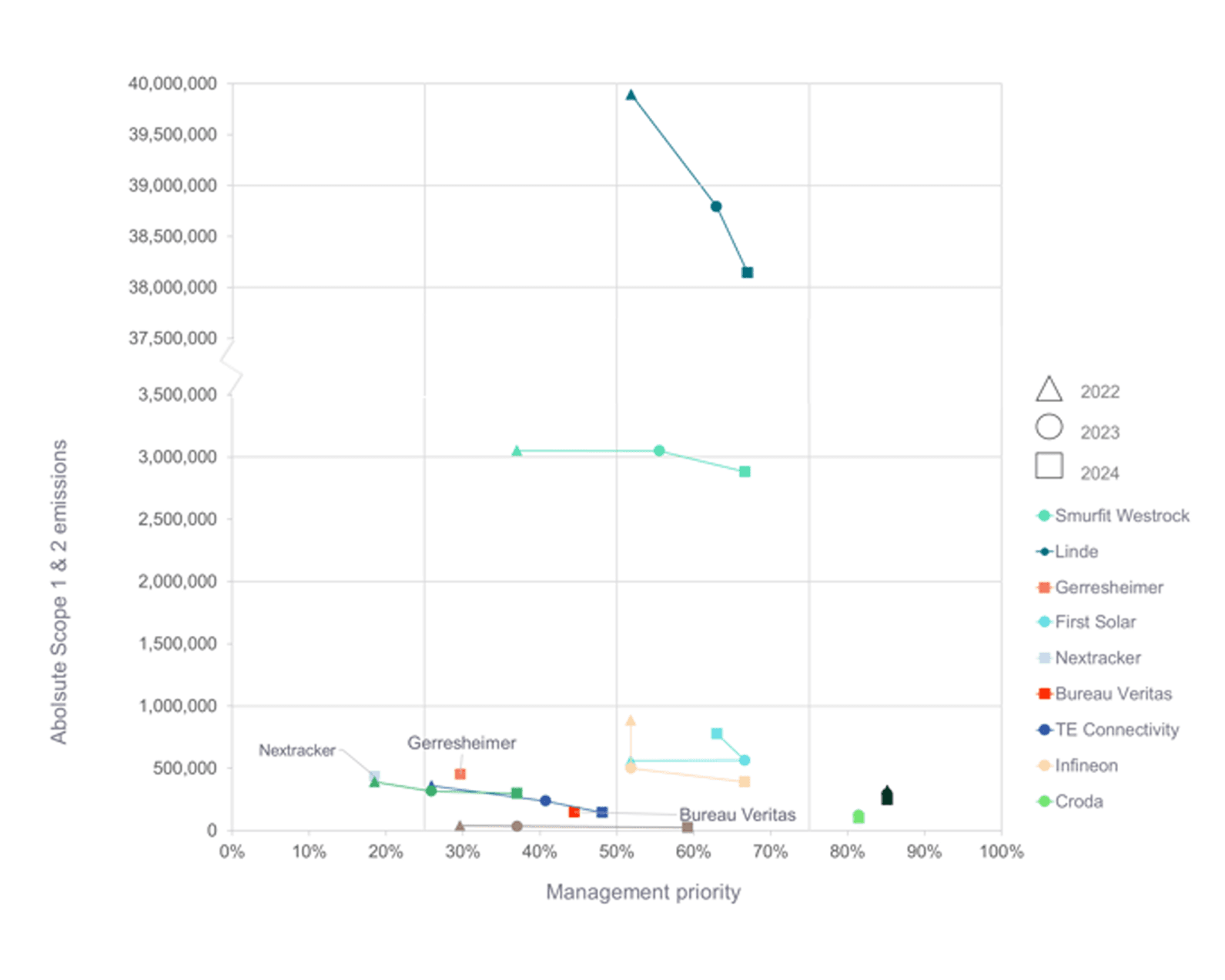
To drive meaningful reductions, we prioritise engaging the top ten emitters, responsible for 80% of the portfolio’s Scope 1 and 2 (financed) emissions.
Progress is evident for nine of these companies from 2022 to 2024 – both in terms of advancements in “management priority” (i.e. alignment of strategy with the Paris agreement) and reporting measurable reductions in absolute emissions (Figure 2).
Notably, TE Connectivity has achieved an impressive 72% reduction in scope 1 and 2 emissions since 2020, driven by significant increase in its renewable energy consumption. This includes a 45% decrease in Scope 2 emissions from FY 2022 to 2023⁴. We commend the company for its achievement, especially as it has been a focus of our engagement efforts throughout 2023 and into 2024 via the Net Zero Engagement Initiative⁵.
The Scope 1 and 2 emissions of First Solar have, however, unfortunately increased over the past year. This is due to the rapid scaling of production that the company has achieved. In 2022 the company manufacturing 9GW of solar modules. In 2024 it is expected to have been over 14GW⁶.
Still, the company took positive steps towards reductions last year, including a commitment to power 70% of its Indian operations with its own solar panels by the end of the year ⁷. This news was gratifying to us along with colleagues from the Investors for Sustainable Solar initiative⁸, as WHEB has been encouraging the company to enhance renewable energy sourcing through its own products.
Figure 2. Absolute Scope 1 & 2 emissions are decreasing for 9 out of 10 of the WHEB Strategy’s top emitters (by financed emissions)⁹
2. Diversity Equity & Inclusion (DEI)
DEI is in our view a moral and a business imperative¹⁰,¹¹. As in previous years, our approach in 2024 focused on gender and was driven by proxy voting¹².
For example, after First Solar's 2024 AGM, we expressed disappointment in its decision to appoint another male board member, missing an opportunity to honour its public commitments to diversity, sustainability, and equity. Conversely, Thermo Fisher Scientific improved female board representation by 10% and achieved 48% female representation across its business¹³, earning our commendation.
Since we began closely monitoring gender diversity in 2018, improvements from companies like Thermo Fisher have become more common, driving the strategy’s gender diversity performance from 19% to 29.6%¹⁴.
But limited data on DEI aspects beyond gender can complicate engagement, particularly with respect to setting targets, highlighting the need to assess alternative indicators of progress¹⁵.
For example, we engaged Infineon¹⁶ to increase the ambition and scope of its diversity targets. Though it does not plan to revise existing goals, the company highlighted its commitment to initiatives like employee resource groups (ERGs), monitoring employee satisfaction, and enabling flexible working arrangements.
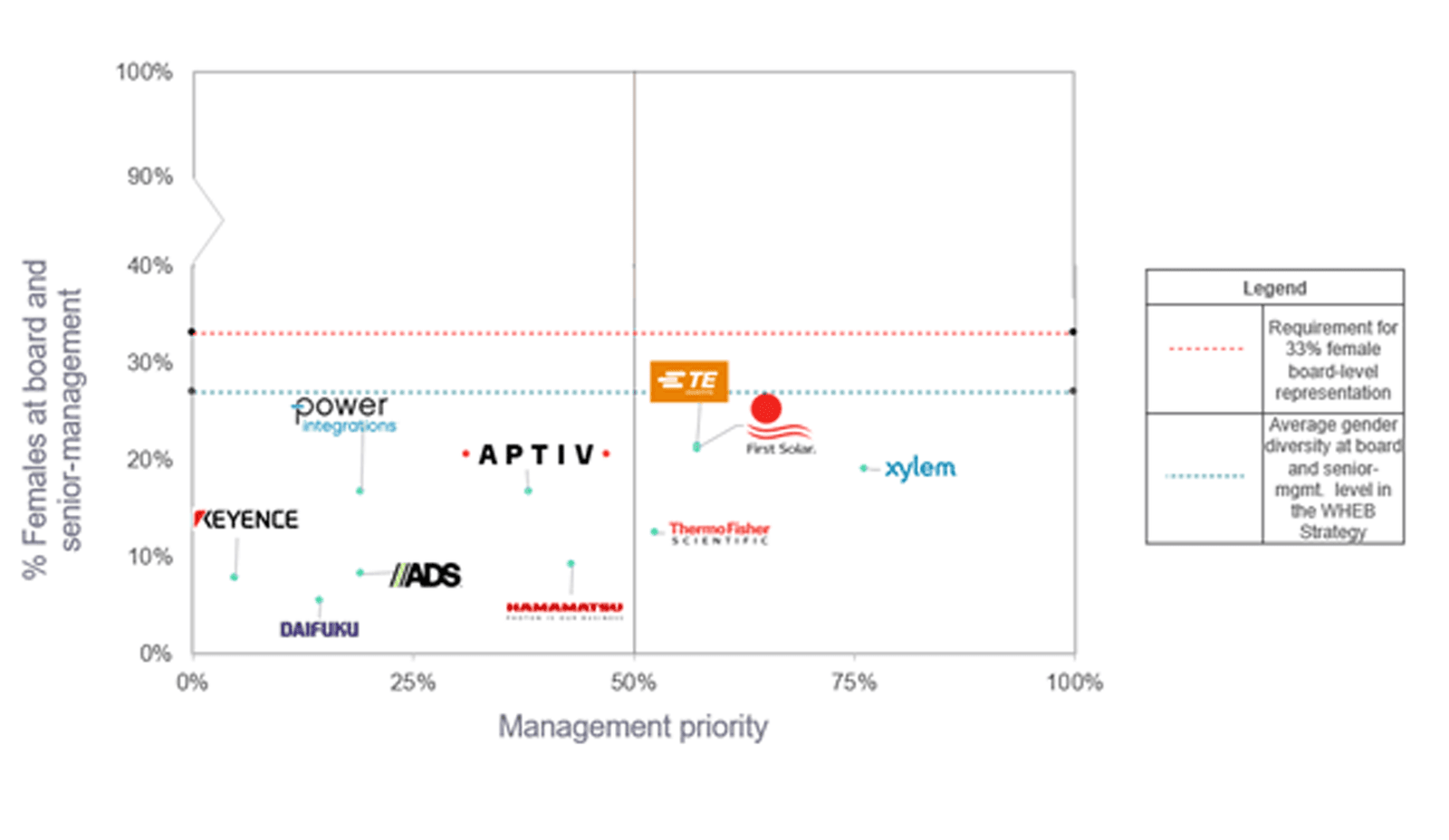
Last year we refined our prioritisation method on DEI by identifying laggards with low senior female representation – a datapoint available across the portfolio - and assessing management’s prioritisation of DEI¹⁷(Figure 3). This will guide 2025 engagement.
Figure 3: Mapping gender diversity priorities within the FP WHEB Sustainability Impact Fund
3. Protecting biodiversity, nature and the environment
In 2024, we advanced on initiatives to enhance ecological outcomes. This included advocating for MSA Safety¹⁸ to commit to a phase-out of PFAS chemicals in firefighter gear, now that PFAS-free alternatives are available. We also led a collaborative engagement with Ecolab through ChemSec’s Investor Initiative on Hazardous Chemicals¹⁹, pushing for a time-bound phase-out of substances of very high concern (SVHC), enhanced product circularity, and better promotion of safer alternatives.
In response to antimicrobial resistance (AMR) becoming a key priority for institutional clients, we joined the Investor Action on Antimicrobial Resistance Initiative (IAAMR)²⁰. We believe our involvement in policy advocacy on AMR through this initiative will complement our investments in companies whose products and services help mitigate the risk of micropollution, which is a key driver of AMR²¹.
4. Supporting a well-functioning sustainable financial system
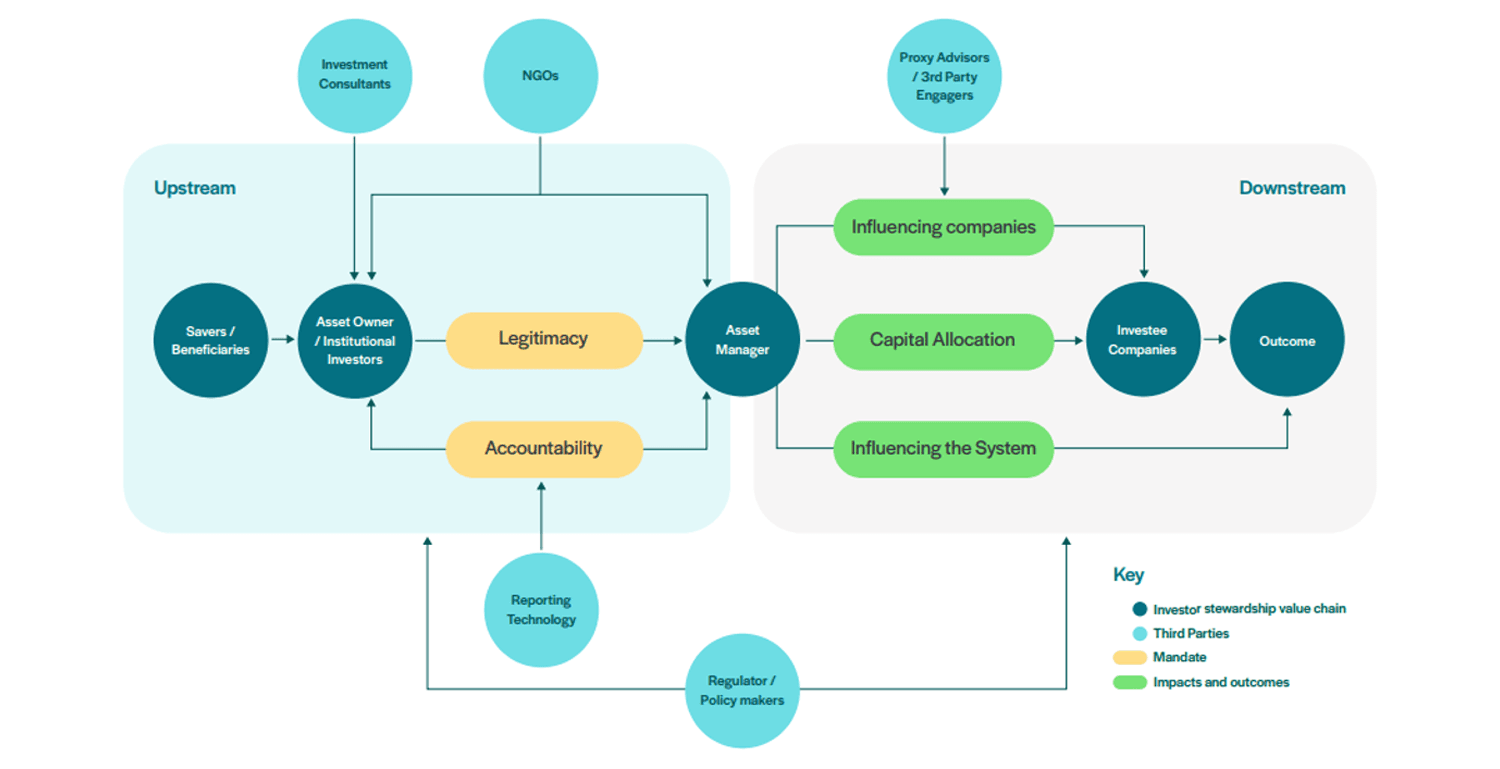
WHEB’s stewardship efforts aim to influence systems more broadly through policy advocacy and contributions to policies, regulations, and thought leadership that advance sustainable investment (Figure 4).
Figure 4: The ‘ecosystem’ of investor stewardship
Key achievements last year included
- The publication of WHEB’s Stewardship White Paper: in which we examine the obstacles to effective stewardship and engagement, highlighting practical solutions employed by WHEB and other practitioners to deliver long-term client value. This paper has been positively received and has been helpful in informing our feedback to the Financial Reporting Council’s (FRC) Stewardship Code Consultation²². Specifically, we are keen for the Code to retain its existing level of ambition for addressing systemic risks, and we hope that the FRC will enable more consistent use of terminology such as ‘objectives’, ‘outcomes’ and ‘activities’.
- SDR Sustainability Impact Label: The FP WHEB Sustainability Impact Fund became the first listed equity fund to use the “Sustainable Impact” label under the Financial Conduct Authority’s Sustainability Disclosure Regime (SDR). This recognition underscores the strength and credibility of WHEB’s stewardship and engagement practices for addressing sustainability risks and opportunities and delivering lasting client value.
Conclusion
Reflecting on 2024, we celebrate significant progress in the portfolio on our key stewardship priorities. We are conscious though that political developments and higher client expectations of stewardship quality could intensify pressures on this practice in the year to come.
Still, we remain optimistic that the foundational work we have undertaken this year will strengthen WHEB’s ability to deliver resilient and impactful investor contribution and long-term client value.
¹ https://www.whebgroup.com/assets/files/uploads/20230424-nzc-policy-portfolio-emissions-final.pdf
² These commitments preceded our involvement with the Net Zero Asset Managers’ Initiative. We note the initiative has decided to suspend activities to track signatory implementation and reporting in order to conduct a review into its appropriateness in the current geopolitical environment. We await the conclusions of the review and in the meantime will continue to report progress against our commitments.
³ This proportion relates to the FP WHEB Sustainability Impact Fund and includes companies that have either a SBTi-validated near term target, a SBTi-validated Net Zero target or companies that have a clearly stated Net Zero Carbon target.
⁴ https://www.te.com/content/dam/te-com/documents/about-te/corporate-responsibility/global/TEConnectivityCorporateResponsibilityReport2023.pdf
⁵ https://www.whebgroup.com/te-connectivity-nzc-case-study
⁶ Based on 3Q2024 company guidance.
⁷ This is expected to displace 7,000 kilotons of CO2e emissions over the 15 year duration of the Power Purchase Agreement.
⁸ https://www.whebgroup.com/engagement-case-study-net-zero-carbon-at-first-solar-q1-2024
⁹Data relates to emissions emitted in 2022, 2021 and 2020 but reported in 2023, 2022 and 2021 respectively.
¹⁰ https://medium.com/@alex.edmans/is-there-really-a-business-case-for-diversity-c58ef67ebffa
¹¹ https://papers.ssrn.com/sol3/papers.cfm?abstract_id=3933687
¹²On average 4-12% of WHEB’s votes against management can be attributed to opposing boards with less than 33% female representation.
¹³ https://corporate.thermofisher.com/content/dam/tfcorpsite/documents/corporate-social-responsibility/annual-reports/2023-CSR-Report.pdf
¹⁴We use Impact Cubed gender equality analysis which looks at the percentage of female executives and board members.
¹⁵ https://www.whebgroup.com/our-thoughts/dei-evolution-looking-beyond-gender-and-facing-the-facts
¹⁶https://www.whebgroup.com/infineon-technologies-2024-q1-case-study
¹⁷ Please refer to our prevous blog on this issue for more details of this assessment: https://www.whebgroup.com/our-thoughts/dei-evolution-looking-beyond-gender-and-facing-the-facts
¹⁸ https://www.whebgroup.com/msa-safety-pfas-phase-out-q3-2024
¹⁹ https://www.whebgroup.com/ecolab-engagement-case-study-chemicals
²⁰ https://amrinvestoraction.org/article/wheb
²¹ https://www.whebgroup.com/our-thoughts/stewardship-in-the-spotlight-managing-micropollution
²² https://www.frc.org.uk/consultations/stewardship-code-consultation/
Risk: The WHEB Environmental Impact Fund, the WHEB Sustainable Impact Fund and the FP WHEB Sustainability Impact Fund are Equity funds. Investors should be willing and able to assume the risks of equity investing. The value of an investment and the income from it can fall as well as rise as a result of market and currency movement; you may not get back the amount originally invested.
This is marketing communication. Please refer to the prospectus, supplement and KIID/KID for the funds, which contain full information on the risks and detailed information on their characteristics and objectives, before making any final investment decisions.
Disclaimer: This insight may provide information about Fund portfolios, including recent activity and performance and may contain facts relating to equity markets and our own interpretation. Any investment decision should take account of the subjectivity of the comments contained in this insight. This insight is provided for information only and all the information contained in it is believed to be reliable but may be inaccurate or incomplete; any opinions stated are honestly held at the time of writing but are not guaranteed. The contents of this insight should not therefore be relied upon. It should not be taken as a recommendation to make an investment in the Funds or to buy or sell individual securities, nor does it constitute an offer for sale.