
Real Assets
Engaging to support the Great British Investment Trust
By Anna Elliott

Our role in collaborative, industry-wide engagement to improve the cost disclosure regime facing UK investment trusts.
An overview of collaborative, industry-wide engagement to restore fairness in the UK investment trust sector. Investment trusts have been required to disclose costs already reflected in their share prices, resulting in double-counting and, ultimately, sell-offs.
Investment trusts have been part of Britain’s financial fabric since 1868, financing infrastructure in the UK and beyond, long before today’s regulatory landscape existed. Yet in recent years, this sector has faced significant headwinds from higher-for-longer interest rates to regulatory challenges, most notably around cost disclosure.
The issue: double-counting costs
In 2022, the Financial Conduct Authority (FCA) issued UK-specific guidance on the application of EU disclosure regimes.1 This required trusts to report ongoing fees in Key Information Documents (KIDs), under a framework designed for open-ended funds
Unlike open-ended funds, as listed companies, investment trust share prices should already reflect management and operating expenses. Adding these costs again in a KID lead, effectively, to double-counting, making them appear more expensive and less attractive.
For example, Octopus Renewables Infrastructure Trust (ORIT) and Boralex, two of our renewable energy holdings, both incur operating costs which should be reflected in their share price. However, unlike Boralex, ORIT, as a UK Investment Trust, had to present these costs separately in a KID, as shown in Figure 1, creating an unfair comparison.

Figure SEQ Figure \* ARABIC 1: Excerpt from ORIT’s KID, dated 03-07-20252.This is misleading to retail investors. It also affects intermediaries such as Independent Financial Advisers (IFAs) and wealth managers, who then need to incorporate these costs in their own disclosures, making their portfolios look more expensive, leading to reduced allocations.
According to Baroness Bowles in 2024, the FCA’s interpretation contributed to:
- A significant drop in money invested in investment trusts, estimated at £7 billion per year.
- A material reduction in permanent equity capital allocated to UK markets.
- Foreign investors acquiring UK real assets at depressed prices3.
Our response: three phases of engagement
As long-term investors in UK infrastructure and shareholders in numerous investment trusts, we have both led and supported efforts to correct this imbalance through coordinated industry engagement and company-level engagement.
Phase 1: Mobilising a united industry voice (FY24)
In response to the FCA guidance and the subsequent position issued by Association of Investment Companies (AIC), we reached out to over 20 portfolio investment trusts who were members of the AIC, representing 48% of Foresight UK Infrastructure Income Fund (FIIF) and 17% of our Global Infrastructure Fund (GRIF). We encouraged them to join us in advocating for urgent reform by:
- Engaging directly with the AIC to request a revision of its position on disclosure requirements.
- Publicly supporting the broader industry campaign.
We also wrote to the Treasury to support excluding investment companies from the forthcoming Consumer Composite Investments (CCI) regime, the FCA’s post-Brexit replacement for the EU regulation, whose disclosure requirements had given rise to these issues, and co-signed a joint submission to the HM Treasury Consultation led by the London Stock Exchange (LSE).
Progress:
The LSE’s letter to the Treasury garnered ‘more than 300 signatories, including 119 investment companies, 33 investors, 25 brokers and 13 research firms, along with numerous MPs and other interested parties’.5 In September 2024, following strong industry lobbying, including efforts by the AIC, the FCA announced a temporary exemption for investment companies from existing cost disclosure rules, a significant win for collective advocacy.
Phase 2: Asking companies to update their KIDs (FY25)
Following the exemption, we engaged directly with the Chairs of our portfolio trusts, encouraging them to update their disclosures (e.g. Figure 1) and set costs to zero.
Progress:
Responses varied, while some trusts acted immediately, others took a more cautious approach. By the end of FY25, around 60% of engaged companies had updated their KIDs (Figure 2). The inconsistent response showed that interim measures alone were insufficient to deliver a market-wide standard.
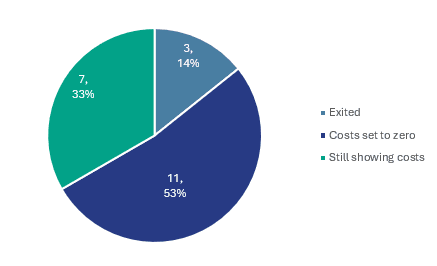
Figure SEQ Figure \* ARABIC 2: Interim state of cost disclosure following Phase 2 engagement (as of March 2025)6.
Phase 3: Advocating for a fair regulatory framework (ongoing)
Following Brexit, the FCA is replacing EU regulation with the new CCI regime and in late 2024, released the draft policy and consultation7,8. Disappointingly, the draft maintained the treatment of investment trusts as analogous to open-ended funds.
In response, we worked with key industry bodies such as the AIC to, once again, deliver a coordinated signal. Our consultation submission centred on three key points:
- Investment company costs are already reflected in share prices, and additional disclosures are therefore misleading.
- Pulling through costs from underlying holdings inflates figures and misrepresents the investor experience.
- Any relevant expenses should be disclosed in audited financial statements, not through synthetic, standardised retail templates designed for different investment structures.
Progress:
Following what the FCA described as a 'vibrant' consultation process, the regulator confirmed it is exploring 'a solution that reflects the unique properties of investment trusts'.9
Outcomes and what’s next
Thanks to industry-wide engagement, meaningful progress has already been made. For example:
- Temporary regulatory relief achieved (Phase 1)
- 76% of FCM’s trust holdings now exclude ongoing charges in their KIDs (Phase 2)
- Regulatory dialogue is underway to achieve a permanent resolution (Phase 3)
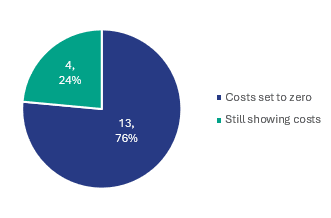
Figure SEQ Figure \* ARABIC 3: Current state of cost disclosures across FCM's investment trust holdings (as of November 2025).
The FCA’s final CCI policy, expected before the end of 2025, will shape how UK Investment Trusts continue to report costs. If it fails to resolve the double-counting issue in the current format, we will continue to push for regulation that ensures a fair, competitive investment landscape. We believe addressing this is critical for the long-term success of UK Investment Trusts and their contribution to the UK economy, most notably through the provision of clean energy and social infrastructure, with ‘over £17bn of assets invested in UK infrastructure including roads, trains, wind and solar farms’.10
For more information about our work engaging with investment trusts, including other sector-specific issues, such as management fee calculations, please refer to the FCM FY2025 Stewardship Report.11
Risk: The FP Foresight Global Real Infrastructure Fund, the FP Foresight UK Infrastructure Income Fund and the FP Foresight Sustainable Real Estate Securities Fund are Equity funds and the FP Foresight Diversified Real Assets Fund is a Multi-Asset fund. Investors should be willing and able to assume the risks of investing in these funds. The value of an investment and the income from it can fall as well as rise as a result of market and currency movement; you may not get back the amount originally invested. The Funds are actively managed with the UK CPI +3% and the FTSE EPRA NAREIT Developed Net TRI GBP used as comparator benchmarks only.
This is marketing communication. Please refer to the prospectus, supplement and KIID/KID for the funds, which contain full information on the risks and detailed information on their characteristics and objectives, before making any final investment decisions.
Disclaimer: This insight may provide information about Fund portfolios, including recent activity and performance and may contain facts relating to equity markets and our own interpretation. Any investment decision should take account of the subjectivity of the comments contained in this insight. This insight is provided for information only and all the information contained in it is believed to be reliable but may be inaccurate or incomplete; any opinions stated are honestly held at the time of writing but are not guaranteed. The contents of this insight should not therefore be relied upon. It should not be taken as a recommendation to make an investment in the Funds or to buy or sell individual securities, nor does it constitute an offer for sale.