Sustainable
The paradox of Emily in Paris
By WHEB Investment Team
Fashion brands' climate pledges are examined against their supply-chain emissions, with Lenzing's wood-pulp fibres offered as one alternative.
Why most brands’ commitments to ‘Sustainable Fashion’ are as empty and vapid as this show’s storyline
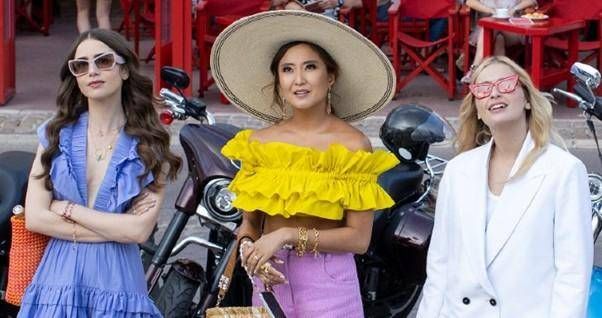
Like a lot of millennials, I spent a sizeable chunk of my Christmas break hate-watching Emily in Paris while staring listlessly at the contents of my wardrobe.
The show follows 30-something marketing exec Emily¹. Emily spends her time pottering around Paris wearing designer clothes, posting videos of herself on Instagram, and effortlessly ascending the career ladder by coming up with edgy new concepts like… Zoom filters.
Over the course of Season 3, which documents a few weeks in Emily’s life, she’s estimated to have worn 43 different outfits. Her style manifesto has three simple commands:
- Always bright.
- Rarely practical.
- Never worn more than once.
Not a great example of responsible consumerism, Netflix.
But wait – the show’s costume designer talks about sustainability all the time! She loves to pair second-hand pieces with high street fashion! She’s been ‘pushing upcycling’ for years!
Like this show’s conflicted costume designer, the fashion industry has been suffering an identity crisis for years. They want to promote sustainability. They want their customers to feel good about buying their clothes.
But this creates a paradox – how can the fashion industry be both profitable and sustainable, when it’s inherently reliant on ever-changing trends?
Fashion companies’ climate pledges need a sustainability makeover
In an attempt to put their best foot forward, 100 fashion brands have committed to a range of climate pledges under the UN Fashion Charter for Climate Action².
This includes a pledge to become ‘Net Zero’ by 2050. This is one way clothing retailers can promote sustainable consumption without completely overhauling consumer behaviour.
During COP27, the UN released new guidance³ on what that Net Zero commitment should look like. Unfortunately, this has unearthed major gaps⁴ in many signatories’ pledges.
One gap looms larger than others. 80% of the fashion companies analysed by STAND.earth, a charity, have failed to set targets to halve their scope 3 (supply chain) emissions by 2030⁵ – one of the UN’s requirements.
This is a huge fail, since scope 3 emissions typically make up over 90% of a clothing company’s greenhouse gas emissions⁶. So in most cases, fashion companies’ climate pledges look like a bunch of empty promises.
But we believe this will change. A combination of investor pressure, regulation, and – perhaps most importantly – the rise in consumer awareness will force the fashion industry to undergo a sustainable makeover.
Because consumers care about this stuff – a lot. A survey by Fashion Revolution found that 80% of respondents want fashion brands to provide detailed information about product environmental impacts⁷. McKinsey, a consultant, surveyed 2,000 people about sustainable fashion in 2020. They found that nearly 70% of consumers consider the use of sustainable materials to be an important factor when purchasing clothes⁸.
WHEB’s investment in Lenzing is more than a fashion statement
At our Annual Investor Conference in November, Seb Beloe and I spoke about how almost 40% of supply chain emissions for the apparel and footwear sector come from material production. This is why WHEB has invested in Lenzing, in our European strategy.
Lenzing manufactures clothing fibres from dissolved wood pulp. These fibres generate around 25-30% less greenhouse gas emissions, and use 90-95% less water, than organic cotton⁹.
We don’t know what those numbers look like against fibres derived from fossil-based feedstocks. This is because Lenzing chose to conduct their lifecycle analysis against a more rigorous baseline. But it’s fair to assume the sustainability benefits will be even greater than those already impressive numbers.
Using Lenzing’s fibres, like Tencel, instead of cotton and polyester can generate huge savings in scope 3 emissions.
They’ve already made their way into stores like H&M, Asos, and Zara, but only in small quantities. They even helped propel the real-life Emily in Paris, influencer Xenia Adonts, to the Forbes '30 Under 30' list with her sustainable fashion brand, Attire.
A sustainable trend
We believe that the fashion industry, driven by consumer and investor pressure, will generate huge demand for Lenzing’s sustainable fibres over the long-term.
This isn’t just good for the environment – it’s also good for business.
Until the disruption caused by the pandemic, Lenzing was commanding a price premium to cotton. We expect this trend to reappear once supply chains have normalised.
The truth is, ‘sustainable fashion’ mostly relies on behavioural change from consumers – buy less, buy better. But even still, there are actions clothing retailers can take to massively reduce the carbon footprint of fashion.
And if you want to do your part, next time you go clothes shopping, check the labels for Tencel.
¹ Incidentally, and perhaps of more interest to some readers than the show itself, Emily is played by Lily Collins the daughter of 80’s crooner Phil Collins.
² https://climateinitiativesplatform.org/index.php/Fashion_Industry_Charter_for_Climate_Action
³https://www.un.org/sites/un2.un.org/files/high-levelexpertgroupupdate7.pdf
⁴ https://stand.earth/insights/are-top-fashion-brands-net-zero-commitments-worth-the-paper-theyre-written-on/
⁵ ibid
⁶ https://unfccc.int/sites/default/files/resource/20_REP_UN20Playbook_V7.pdf
⁷ https://issuu.com/fashionrevolution/docs/fashrev_consumersurvey_2020_keyfindings
⁸https://www.mckinsey.com/industries/retail/our-insights/survey-consumer-sentiment-on-sustainability-in-fashion
⁹ Sourced from Lenzing’s Investor Relations team.
Risk: The WHEB Environmental Impact Fund, the WHEB Sustainable Impact Fund and the FP WHEB Sustainability Impact Fund are Equity funds. Investors should be willing and able to assume the risks of equity investing. The value of an investment and the income from it can fall as well as rise as a result of market and currency movement; you may not get back the amount originally invested.
This is marketing communication. Please refer to the prospectus, supplement and KIID/KID for the funds, which contain full information on the risks and detailed information on their characteristics and objectives, before making any final investment decisions.
Disclaimer: This insight may provide information about Fund portfolios, including recent activity and performance and may contain facts relating to equity markets and our own interpretation. Any investment decision should take account of the subjectivity of the comments contained in this insight. This insight is provided for information only and all the information contained in it is believed to be reliable but may be inaccurate or incomplete; any opinions stated are honestly held at the time of writing but are not guaranteed. The contents of this insight should not therefore be relied upon. It should not be taken as a recommendation to make an investment in the Funds or to buy or sell individual securities, nor does it constitute an offer for sale.