
Sustainable
Stewardship in the Spotlight: Managing micropollution
By Rachael Monteiro

An account of the health and economic costs of micropollutants such as PFAS, and the company engagements that WHEB has used to address them.
This insight was originally produced by WHEB Asset Management, now part of Guinness Global Investors.
Micropollutants: Unseen yet ubiquitous
It’s an unfortunate reality that by the time we have simply taken a shower¹, grabbed lunch on-the-go, made dinner and then collapsed on the couch after doing the dishes², we’ve likely come into contact with a multitude of harmful substances.
Naked to the human eye, ‘micropollutants’ - tiny man-made molecules that include antibiotic residues, synthetic hormones, pesticides, and industrial chemicals, such as per and polyfluoroalkyl substances (known as PFAS) - are lurking everywhere, creating a planetary-scale health risk. This includes places previously considered relatively untouched by humans. PFAS varieties have been detected in the Mariana Trench and Antarctica³.
Conventional wastewater treatment does not remove these micropollutants, so they end up back in the natural environment, ultimately bioaccumulating at the top of the food chain, in us.
Although at acute and small concentrations micropollutants are unlikely to have long-lasting health impacts, chronic exposures have been linked to a range of serious health conditions. PFAS chemicals, for example, have been linked to cancers, autoimmune disorders, male and female infertility, obesity and diabetes⁴,⁵. Meanwhile, overuse of antibiotics and disinfectants is accelerating antimicrobial resistance (AMR) not just in bacteria, but also in viruses, fungi and parasites⁶.
Following a 2023 assessment, it’s now estimated that the safe planetary boundary for pollutants ("novel entities" in Figure 1) has been exceeded⁷, putting the stability of the Earth system at risk.
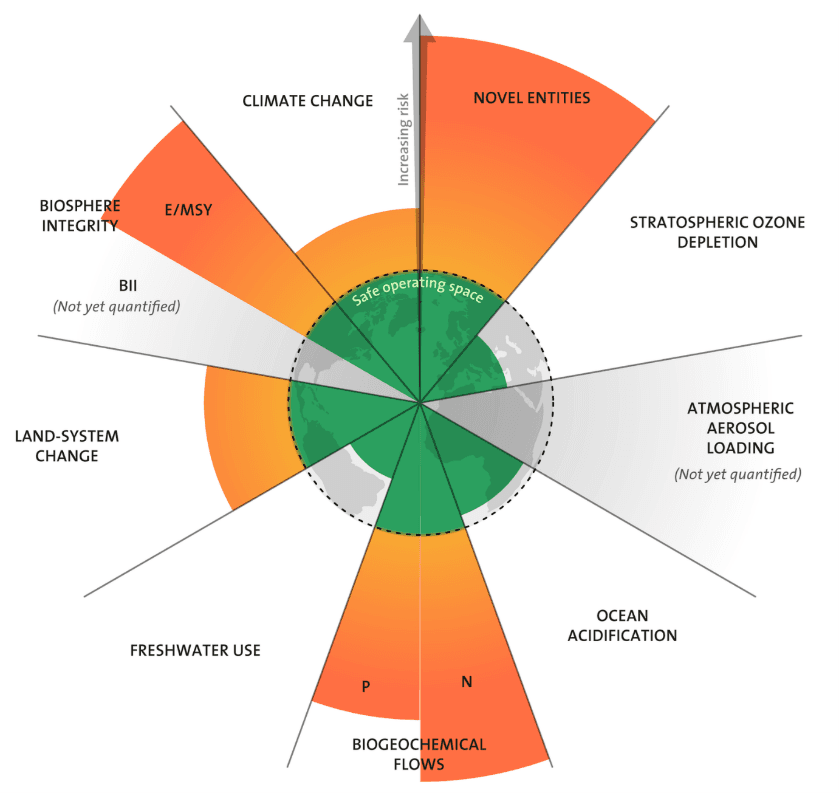
Left unaddressed, the human and economic costs of micropollution will be severe. UNEP for example estimate 10 million deaths annually due to AMR by 2050 – equal to the number of deaths from cancer in 2020⁹. Meanwhile, the World Bank puts the cost of healthcare associated with AMR at around USD $1 trillion by the same timeframe¹⁰.
The numbers reach even dizzier heights when PFAS enter the equation. It’s thought that the bill for related direct-healthcare and environmental remediation could be as much as $17.5 trillion across the global economy¹¹.
Thankfully, the legal and regulatory landscape is beginning to catch up. In early April 2024, the U.S. Environmental Protection Agency (EPA) introduced the first legally enforceable limits on certain PFAS-levels¹² in drinking water. However, a systemic problem requires systemic action, meaning financial markets have a role to play too.
Our role in managing the problem
Reducing risk
At WHEB, we have been addressing the risk of micropollution through our stewardship and engagement activities for over a decade. In recent years we have joined several investor initiatives to support different aspects of our work on the topic. In fact in 2023, c.6% of our engagement activities focused on topics related to micropollution:
Though not a manufacturer of PFAS chemicals, MSA Safety use the chemicals in meeting regulatory water and oil resistance requirements in protective firefighter turn-out gear made. In light of regulatory and technological developments, we have sought to get the company to commit to a time-bound phase-out of the chemicals. So far this has been challenging due to its reliance on supplier R&D. Still, MSA Safety has actively been working with the International Association of Firefighters to support the PFAS Alternatives Act, which would secure federal funding to support innovation.
Since 2021, we have been leading a collaborative engagement with Ecolab via ChemSec’s Investor Initiative on Hazardous Chemicals. Ecolab’s cleaning products and services enable better water and energy efficiency in a range of downstream industries. However, a small number of its products contain substances of very high concern (SVHC). Here we have sought to secure a commitment from the company for a time-bound phase-out of SVHCs, as well as improved product circularity and better marketing of its safer alternative products¹³.
Along with our partners in the Investors for Sustainable Solar¹⁴ initiative, we have been encouraging solar pv manufacturer First Solar on the safe use of Cadmium Telluride, a heavy metal, in their panels as well as on the use of alternatives to other toxic chemicals (such as in solvents) that are used in the manufacturing process for solar panels.
We also believe that investors can, and should, utlise policy advocacy as a complementary method to direct company engagement. WHEB is therefore in the process of joining the Investor Action on AMR Initiative¹⁵. We hope this initiative will further support investor efforts to address AMR globally, and complement our own direct engagements.
Empowering solution providers
As impact specialists our investments support companies providing solutions to sustainability challenges, including those helping to tackle micropollution. Recent regulatory developments, such as with the US EPA, will likely benefit portfolio holdings that provide the technologies to address micropollution in its various forms. These stocks include:
- Xylem, a provider of advanced water treatment technologies, has over 80 municipal and industrial customers using its PFAS mitigation installations in the US alone. In addition, its innovative MitiGATORTM Mobile treatment system is enabling utilities to rapidly comply with new EPA regulations¹⁶ and it is currently fast-tracking innovations in advanced pathogen detection and leak detection¹⁷.
- Veralto, a recent spin-out of Danaher’s water quality businesses, is a leader in the detection of PFAS chemicals.
- Stormwater treatment systems supplied by Advanced Drainage Systems filter pollutants like hydrocarbons and heavy metals.
- STERIS’s main business is in sterilisation services for hospitals and pharmaceutical companies. Their products and services are specifically designed to help eliminate the risk that AMR pathogens contaminate and multiply in healthcare settings.
In short, WHEB’s efforts to address micropollution span various fronts: strategic investments in companies providing solutions, direct engagements with companies, bolstered by the coordination and expertise of relevant initiatives and policy advocacy . Through these channels, we continue to actively address the problem of micropollution with an approach that underscores our commitment to positive impact.
____________________________________________________________________________
¹ Parabens found in many shampoos
² Food packaging, nonstick pans, waterproof outdoor clothing and stain-resistant technologies used for household fabrics have all been found to contain PFAS chemcials.
³ https://chemsec.org/wrappedinchemicals/facts/pfas-fact-4/
⁴ https://www.sciencedirect.com/science/article/pii/S0160412019305380#bb0005
⁵ https://www.nature.com/articles/s41370-018-0094-1
⁶ https://www.sciencedirect.com/science/article/abs/pii/S0966842X1730210X
⁷ https://pubs.acs.org/doi/10.1021/acs.est.1c04158
⁸ https://www.stockholmresilience.org/research/research-news/2022-01-18-safe-planetary-boundary-for-pollutants-including-plastics-exceeded-say-researchers.html
⁹ https://www.unep.org/news-and-stories/press-release/reduce-superbugs-world-must-cut-down-pollution
¹⁰ https://www.who.int/news-room/fact-sheets/detail/antimicrobial-resistance
¹ ¹https://chemsec.org/reports/the-top-12-pfas-producers-in-the-world-and-the-staggering-societal-costs-of-pfas-pollution/
¹² https://www.reuters.com/world/us/us-sets-first-standard-curb-forever-chemicals-drinking-water-2024-04-10/
¹³ Detailed Q4 2023 case study: https://www.whebgroup.com/ecolab-engagement-case-study-chemicals
¹⁴ https://iehn.org/our-work/investors-for-sustainablesolar#:~:text=Investors%20for%20Sustainable%20Solar%20is,and20Asset%20Management%20LLP.
¹⁵ The Investor Action on AMR Initiative is a coalition between the Access to Medicine Foundation, FAIRR Initivative and UK Government
¹⁶ https://www.xylem.com/en-uk/about-xylem/newsroom/press-releases/mobile-technology-helps-us-water-utilities-achieve-compliance-with-new-pfas-rules/¹⁷https://www.xylem.com/en-uk/about-xylem/newsroom/press-releases/new-wave-of-startups-scale-innovation-to-solve-global-water-challenges/
Risk: The WHEB Environmental Impact Fund, the WHEB Sustainable Impact Fund and the FP WHEB Sustainability Impact Fund are Equity funds. Investors should be willing and able to assume the risks of equity investing. The value of an investment and the income from it can fall as well as rise as a result of market and currency movement; you may not get back the amount originally invested.
This is marketing communication. Please refer to the prospectus, supplement and KIID/KID for the funds, which contain full information on the risks and detailed information on their characteristics and objectives, before making any final investment decisions.
Disclaimer: This insight may provide information about Fund portfolios, including recent activity and performance and may contain facts relating to equity markets and our own interpretation. Any investment decision should take account of the subjectivity of the comments contained in this insight. This insight is provided for information only and all the information contained in it is believed to be reliable but may be inaccurate or incomplete; any opinions stated are honestly held at the time of writing but are not guaranteed. The contents of this insight should not therefore be relied upon. It should not be taken as a recommendation to make an investment in the Funds or to buy or sell individual securities, nor does it constitute an offer for sale.