Sustainable & Impact
How are heatwaves and drought reshaping clean energy investment?
By Anna Elliott

From French nuclear shutdowns to Europe’s weakest hydropower output in over a decade, this summer’s heat and drought have exposed weak points in the region’s power system. Crucially, this vulnerability varies sharply by technology, with wind and solar proving far more resilient. In this insight, we assess how each technology copes with hotter, drier summers, and explain why adaptation is essential for the energy transition.
On 3 August, Romania’s navy carried out a controlled explosion in the Danube. The goal was to channel water towards the Cernavodă nuclear power plant, where low river levels had already forced one of Romania’s two reactors offline. Between them, they supply around 20% of the country’s electricity.[1]
Romania’s defence minister put the trade-off simply: ‘A day of it functioning is three times more efficient than the costs of this operation’. The country recently declared a state of energy emergency, asking companies and individuals to cut their energy usage.[2]
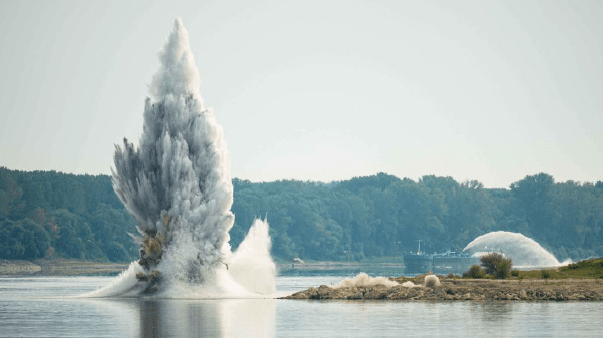
Figure 1: Controlled explosion in the Danube to redirect water towards Cernavodă[3]
Romania’s experience is also reflected across Europe as a whole. The region has endured the hottest June-July period on record and this, combined with much drier-than-average conditions, has caused widespread droughts and forest fires.[4]
These conditions have also disrupted power production across the continent. For example, low river levels have disrupted coal power plants in Serbia, reduced nuclear generation in Hungary and contributed to Europe's weakest hydropower generation in more than a decade. Austrian utility Verbund blamed drought conditions for roughly €370 million in lost earnings for H1 2026, compared to “normal” year. [5],[6]
France has been particularly badly hit seeing up to 23GW of nuclear capacity shut down in June while the country faced extreme heat and high electricity demand.[7]
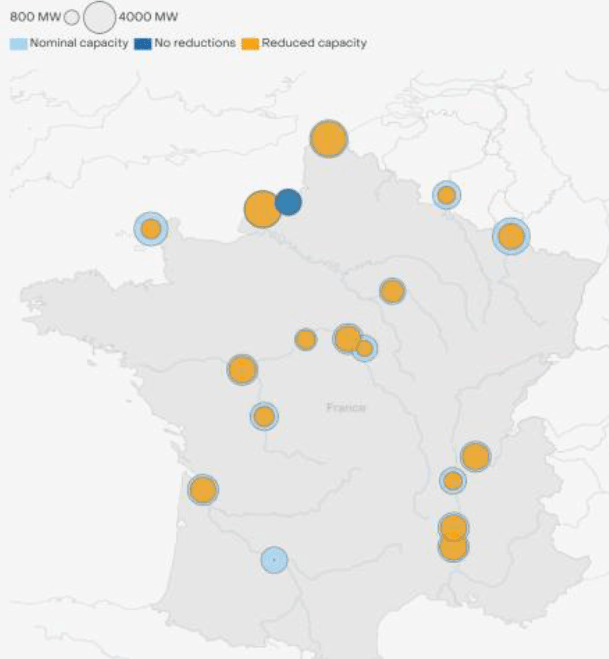
Figure 2: Map of French nuclear capacity reductions in June 2025 [8]
Meanwhile demand for electricity for data centres, heat pumps and EVs is all accelerating. So how prepared is Europe’s electricity system to handle these conditions?[9]
Comparing resilience across technologies
The table below compares Europe’s main generation technologies against two related but distinct stresses: extreme heat and drought. In practice, the exact impact depends on asset-level factors, such as location, design, technology, local regulation and the surrounding grid. However, a simplified overview provides some clear differences.
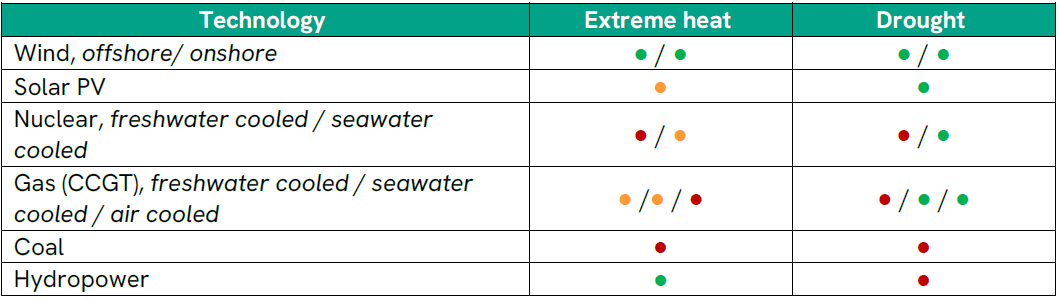
Figure 3: Illustrative table showing the relative direct impacts on extreme heat and drought on dominant electricity generation methods in Europe. green = little to no direct impact, red = significant direct risk
Wind and solar: weather-dependent but surprisingly resilient
Leading the table, offshore and onshore wind have no meaningful water dependencies during operation, making them extremely drought resilient. Heat also has limited direct effects. Most modern turbines operate well across a wide temperature range though the highest temperatures do lead to some derating and efficiency losses, but not widespread shutdowns.[10]
Beyond direct impacts, wind output remains variable, and hot high-pressure systems can coincide with lower wind speeds and so-called "wind droughts". However, this is a feature of the resource itself rather than a vulnerability to heat or water stress, and studies remain inconclusive.[11]
Solar arrays, with no water requirements, also perform well in drought conditions. Extreme heat does however, impact on generation efficiency, which drops by around 0.5% per °C above 25°C.[12] This phenomenon only affects poly-crystalline solar modules. Thin-film modules, like those produced by WHEB holding First Solar, experience smaller losses.
The company estimates that as a result their modules have up to 4% higher annual energy production in hot climates.[13] Efficiency is only part of the picture though. Periods of extreme heat typically align with higher solar irradiation which generally results in higher net power generation.[14] During Europe's 2025 and 2026 heatwaves, we have seen record solar generation, supporting grids experiencing high demand from cooling systems. [15],[16]
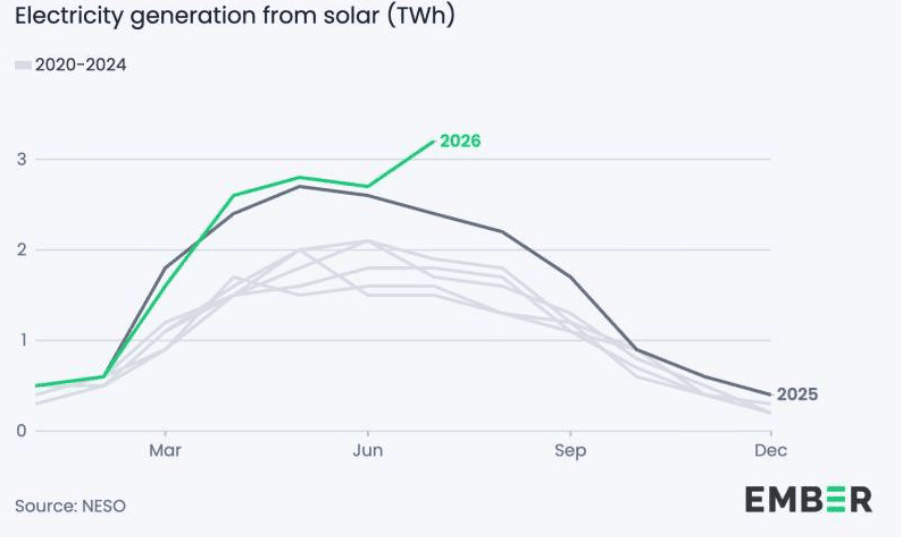
Figure 4: Graph showing record solar generation in Britain in June 2026 [17]
The issue is timing. Heat-related electricity demand does not conveniently disappear when the sun sets. This is where storage, interconnection and demand flexibility become more important. BloombergNEF analysis warns that solar deployment continues to outpace the required storage deployment in European markets. This leads to daytime curtailment and evening price spikes.[18]
How do drought and heatwaves affect power generation?
Hydropower is the clearest example of where water stress directly affects generation, acting as the fuel itself. Lower rainfall, river flows and reservoir levels often translate directly into lower generation. Reservoirs also often have multiple purposes and drought can create tensions between hydropower, irrigation, drinking water and ecological needs.[19] Extreme heat on the other hand poses little direct risk, with the main concerns being the indirect impact on water availability due to increased evaporation.[20]
Thermal plants face a different version of the same problem. Nuclear, gas and coal are very different technologies, with different emission profiles. That said, the majority rely on vast amounts of water for cooling, making them highly vulnerable when water for cooling is inadequate either because volumes are too low or temperatures are too high.
Nuclear power is particularly vulnerable because it (rightly) operates within very strict safety standards. River-cooled nuclear facilities are among those most exposed to heatwaves and drought conditions. As with the Romanian example, often having to shut down completely. For plants cooled by seawater, the impact of temperature and drought are naturally much lower, making them more resilient, although high temperatures can still reduce efficiency.[21]
Gas and coal face similar issues, though generally with a more gradual efficiency effect.[22] Coal is more exposed than gas because it is less thermally efficient, so more waste heat has to be rejected. Serbia’s Kostolac coal-fired plants had to cut output this summer because of a lack of water availability.[23]
These plants can be better adapted for heat and/or drought by being more efficient (less waste heat per unit of energy output or through better water management. Kurita, a holding in the WHEB impact strategy helps improve water treatment. One CCGT plant saw 11,000m³ of water savings per year while reducing emissions and costs.[24]
What does this mean for impact investors?
This summer has reinforced that the energy transition cannot be viewed solely through a mitigation lens. Clean power remains essential, because reducing emissions is still the most effective way of limiting future climate change. Yet low-carbon energy sources are not immune to the impacts of warmer, drier summers.
Nuclear and hydropower provide highly valuable low-carbon electricity but remain vulnerable to drought and water stress depending on their location and design. While coastal thermal plants are more resilient to the acute risks considered here, we have not considered chronic physical risks, such as sea-level rise or coastal flooding. Wind and solar have minimal water dependencies, but their contribution depends on storage, grid flexibility and wider system integration.
Companies like Vestas and First Solar are key to mitigating climate risk by displacing higher-emissions power sources. Whilst already more resilient than thermal counterparts, they are also positioning themselves for a warmer climate. Vestas has added CoolerTop® technologies to extend operating temperature ranges and First Solar's thin-film technology sees better performance at higher temperatures than traditional panels.[25] [26]
Beyond clean energy, water management is a key theme in the WHEB strategy. Holdings such as Kurita, Ecolab and Xylem help customers reduce water consumption. As water availability has become a bigger constraint across sectors, these types of solutions have become increasingly important. Severn Trent, a water utility, is investing increasingly in nature-based solutions, recognising that healthy catchments, rivers and ecosystems can play an important role in improving long-term water security.[27]
We must couple mitigation with adaptation and consider all investments through both lenses as the climate changes, not letting one obscure the other, to build a more resilient and future-proofed energy system.
Read more about impact investing at Guinness
[2] Source: Guardian. https://www.theguardian.com/world/live/2026/aug/03/europe-heatwave-wildfires-migration-ceuta-spain-latest-news-updates
[3] Source: Guardian. https://www.theguardian.com/world/live/2026/aug/03/europe-heatwave-wildfires-migration-ceuta-spain-latest-news-updates
[7] https://ember-energy.org/latest-insights/heat-and-power-impacts-of-the-2025-heatwave-in-europe/
[8] Source: Ember. https://ember-energy.org/latest-insights/heat-and-power-impacts-of-the-2025-heatwave-in-europe/
[9] https://www.iea.org/reports/power-systems-in-transition/climate-resilience
[10] https://www.sciencedirect.com/science/article/abs/pii/S1364032124007093
[13] https://www.firstsolar.com/en/Technology/CadTel
[14] https://ember-energy.org/latest-insights/heat-and-power-impacts-of-the-2025-heatwave-in-europe/
[15] https://ember-energy.org/latest-insights/heat-and-power-impacts-of-the-2025-heatwave-in-europe/
[16] Ember on LinkedIn, 09/08/2026.
[17] Ember on LinkedIn, 09/08/2026.
[18] https://www.bnef.com/news/teyj48kiupsx00
[19] https://www.sciencedirect.com/science/article/abs/pii/S0306261924018233
[22] https://www.iea.org/reports/power-systems-in-transition/climate-resilience
[24] https://www.kurita.eu/en/energy-water-savings-through-total-iron-control/
[25] https://www.firstsolar.com/en/Technology/CadTel
[26] https://www.vestas.com/en/energy-solutions/onshore-wind-turbines/enventus-platform/V172-7-2-MW
Risk: The FP WHEB Sustainability Impact Fund, the WHEB Environmental Impact Fund and the WHEB Sustainable Impact Fund are Equity funds. Investors should be willing and able to assume the risks of equity investing. The value of an investment and the income from it can fall as well as rise as a result of market and currency movement; you may not get back the amount originally invested.
This is marketing communication. Please refer to the prospectus, supplement and KIID/KID for the funds, which contain full information on the risks and detailed information on their characteristics and objectives, before making any final investment decisions.
Disclaimer: This insight may provide information about Fund portfolios, including recent activity and performance and may contain facts relating to equity markets and our own interpretation. Any investment decision should take account of the subjectivity of the comments contained in this insight. This insight is provided for information only and all the information contained in it is believed to be reliable but may be inaccurate or incomplete; any opinions stated are honestly held at the time of writing but are not guaranteed. The contents of this insight should not therefore be relied upon. It should not be taken as a recommendation to make an investment in the Funds or to buy or sell individual securities, nor does it constitute an offer for sale.