
Sustainable
Scrubbing in together: Surgical robots and the future of the operating room
By WHEB Investment Team
Robot-assisted techniques are changing minimally invasive spinal surgery: why Globus Medical is included in the WHEB portfolio.
This insight was originally produced by WHEB Asset Management, now part of Guinness Global Investors.
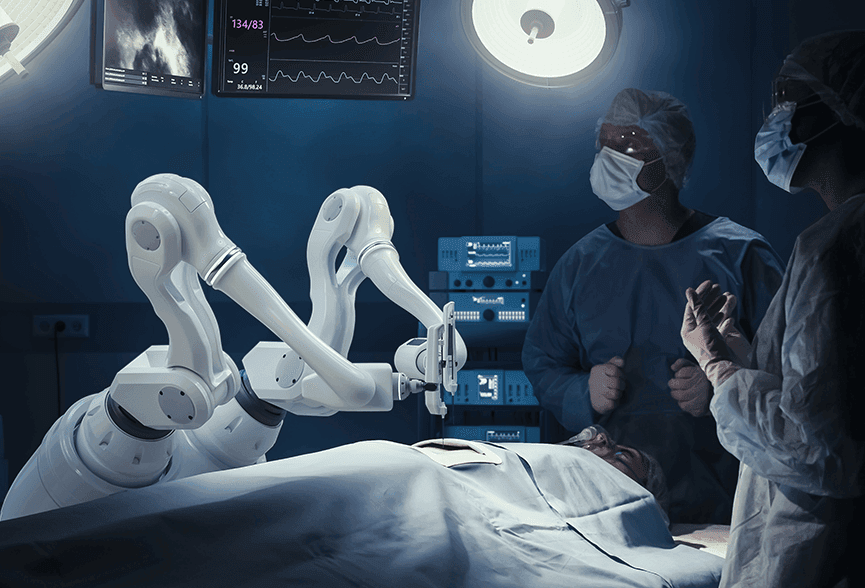
The lights illuminate the sterile operating room, directing attention to the anesthetised form. Equipment and screens hum quietly as the robotic system waits, its metallic arms poised high. As the surgeon begins the procedure, a three-dimensional model of the patient’s spine appears on the monitor, showcasing the surgical plan and intricate details of the vertebrae. Guided by advanced algorithms and real-time imaging, the robot arm, supervised by the surgeon, starts moving slowly towards the patient…
When you think of robotics, you might think of automated metallic factories, looping conveyor belts, trundling delivery robots or you might even picture nippy robotic pets gambolling by the roadside. Moving robotic arms performing surgical procedures is normally not the first thing that comes to mind.
The field of surgery has undergone a revolution with the integration of advanced technologies such as optoelectronics, robotics, and digital systems. This convergence has led to the development of minimally invasive (MI) surgery, which uses specialised instruments inserted through tiny incisions¹. Compared to traditional open surgery, MI techniques reduce blood loss, speed up healing, and improve recovery outcomes.
Robot-assisted surgery
Robot-assisted surgery (RAS) is a form of minimally invasive surgery that leverages robotic systems to perform complex procedures with heightened precision. Robotic technology in orthopaedics was incorporated as far back as 1992, with the ROBODOC, for total hip replacement surgery².
Robotic systems can enable greater precision, overcoming human limitations like hand tremors or fatigue, and providing better access to challenging anatomical areas. Patients benefit from shorter hospital stays, reduced psychological stress, and lower radiation exposure through advanced navigation technologies³. However, challenges such as high equipment costs, extensive training requirements and occasional technical glitches remain.
Spinal applications
Now picture this, a cage like structure that grows and changes over time and is a conduit for over one million electrical messages per day.
The human spine is a complex structure and contains 120 muscles, around 220 ligaments, and 100 joints⁴. In fact people can be taller by 0.5 to 1.5 cm upon waking in the morning and become shorter over the day due to spinal compression⁵.
Using minimally invasive techniques and laparoscopes allows the surgeon to separate the muscles surrounding the spine with small incisions rather than cutting through them. When using manual laparoscopic instruments, surgeons carry out opposing movements within tiny incisions, often leaning, stooping or stretched out at awkward angles leading to fatigue, strain and injury.
Robotic assistance enhances these procedures by translating surgeons' hand movements into precise actions, smoothing tremors, and allowing for finer manipulations. Advanced imaging systems, including CT and MRI scans, help create detailed 3D models of the spine, enabling surgeons to pre-plan procedures and guide robotic arms during surgery. This approach minimizes damage to nearby nerves, blood vessels, and organs, making it particularly effective for complex surgeries like spinal fusions or instrumentation placement⁶.
Globus Medical
Included in the WHEB portfolio is Globus Medical, a leader in innovative spinal surgery systems. The company specialises in spinal implant systems, scoliosis correction tools, disc replacement technologies and advanced material technologies. Its flagship product, ExcelsiusGPS™, integrates robotics and navigation technologies to enhance surgical accuracy. This system allows surgeons to customise procedures based on each patient’s anatomy, reducing operative time and improving safety.
By 2021, over 20,000 spinal procedures had been performed using the ExcelsiusGPS™ system⁷. In the UK, the NHS and Globus Medical have a partnership to introduce robotic navigation in spinal surgeries that started with the Oxford University Hospitals NHS Foundation Trust and the Walton Centre NHS Foundation Trust Liverpool⁸ in 2022.
We expect Globus Medical’s revenues to grow by mid to high single-digits percentage over the coming years. This is mainly based on the expected double-digit growth of its “Enabling Technologies” segment that includes the ExcelsiusGPS™ product suite. In addition, the successful post-merger integration of NuVasive is expected to allow for a steady margin expansion during the same period. With a focus on continuous innovation, Globus is exploring artificial intelligence and advanced navigation systems to refine surgical techniques further.
The future
The next frontier in robotic surgery could be telesurgery—where surgeons operate remotely on patients in different locations. The first telesurgery took place in 2001, when a surgical team in New York used the ZEUS robotic system to perform surgery on a patient in France⁹.
Future advancements in augmented reality (AR) and virtual reality (VR) could enhance success by providing real-time overlays of medical imaging and anatomical structures for greater precision¹⁰. While a number of pre-clinical testing surgeries have been conducted on live humans and animals¹¹, challenges such as data latency, cybersecurity, data privacy and the danger of technical malfunction still need to be addressed before these futuristic technologies become routine in healthcare settings.
The robotic arm retracts as the procedure concludes, the monitors dim. Yet, the future of the operating room is far from silent—it hums with the promise of what human and technological collaborations can achieve.
¹ https://www.hospitalmanagement.net/features/feature634/
² https://boneandjoint.org.uk/article/10.1302/0301-620x.93b10.27418
³ https://pmc.ncbi.nlm.nih.gov/articles/PMC8657248/
⁴ https://www.treatingpain.com/news-updates/2019/july/5-surprising-facts-about-the-spine-you-never-kne/
⁵ https://www.thelancet.com/journals/lancet/article/PIIS0140-6736(05)78342-2/fulltext
⁶ https://www.theguardian.com/society/2018/jul/04/robots-nhs-surgeons-keyhole-surgery-versius
https://www.theguardian.com/science/2023/jun/18/robot-surgeons-provide-many-benefits-but-how-autonomous-should-they-be
⁷ https://www.surgicalroboticstechnology.com/news/globus-medical-celebrates-20000-procedures-with-excelsiusgps/
⁸ https://www.spinalsurgerynews.com/2022/11/globus-medical-partners-with-the-uks-nhs-to-provide-hospitals-with-surgical-robotic-navigation-technology/110370
⁹ https://pmc.ncbi.nlm.nih.gov/articles/PMC6067812/
¹⁰ https://sloanmedical.com/how-9-breakthrough-technologies-are-shaping-the-future-of-surgery/
¹¹ https://link.springer.com/article/10.1007/s11701-024-01984-w
Risk: The WHEB Environmental Impact Fund, the WHEB Sustainable Impact Fund and the FP WHEB Sustainability Impact Fund are Equity funds. Investors should be willing and able to assume the risks of equity investing. The value of an investment and the income from it can fall as well as rise as a result of market and currency movement; you may not get back the amount originally invested.
This is marketing communication. Please refer to the prospectus, supplement and KIID/KID for the funds, which contain full information on the risks and detailed information on their characteristics and objectives, before making any final investment decisions.
Disclaimer: This insight may provide information about Fund portfolios, including recent activity and performance and may contain facts relating to equity markets and our own interpretation. Any investment decision should take account of the subjectivity of the comments contained in this insight. This insight is provided for information only and all the information contained in it is believed to be reliable but may be inaccurate or incomplete; any opinions stated are honestly held at the time of writing but are not guaranteed. The contents of this insight should not therefore be relied upon. It should not be taken as a recommendation to make an investment in the Funds or to buy or sell individual securities, nor does it constitute an offer for sale.