
Sustainable
Ozempic – Is Novo Nordisk’s diabetes and weight loss drug a miracle or a menace?
By WHEB Investment Team
An assessment of semaglutide, sold as Ozempic and Wegovy, the scale of obesity it addresses and the debate over weight-loss medication.
In a society riddled with low self-esteem and mental health issues, weight loss can be a controversial and difficult topic.
Pop culture and social media do more harm than good, often promoting unhealthy and inaccurate information. Kim K’s recent quest to fit into Marilyn Monroe’s crystal gown – in which she lost 16 pounds in 3 weeks – is a striking example of how celebrities spread damaging views to the masses.
Today’s celeb slimming method du jour is Ozempic. Ozempic is a medication sold by Novo Nordisk to treat patients with type 2 diabetes. It is the sister medication to Wegovy, a higher dose version which treats patients suffering with obesity. Both medications are brand names for semaglutide, a drug which manages patients’ blood glucose levels, reducing their appetite and helping them to feel fuller for longer.
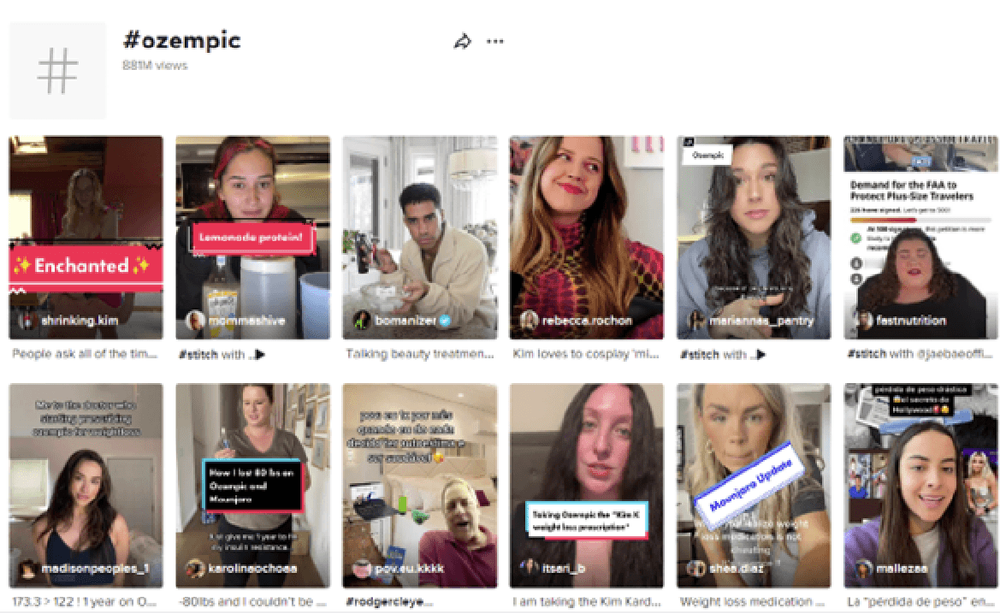
The public reaction to Ozempic has been frenzied. Videos on TikTok tagged with #Ozempic have nearly 900 million views. Entertainment press is rife with rumours about which celebs are on the “miracle weight loss drug”. It was even used as a punchline by Jimmy Kimmel at this year’s Oscars.
Given our investment in Novo Nordisk, in our European strategy, it’s been important for us to separate the fact from the noise. Despite the controversy, it is our view that semaglutide has the potential for ground-breaking positive impact on public health.
Here’s why.
Obesity is a public health epidemic
According to the World Health Organization, around one in ten of the world’s adults are obese¹. The situation in America is particularly severe – nearly 75% of American adults, and one in five American children, are either overweight or obese².
And this problem is only getting worse. According to the World Obesity Federation, more than a billion people around the world will be obese by 2030 – double the number there were in 2010³.
Obesity is generally not considered a disease. But it has been strongly linked to some very serious diseases. One meta-study found that obesity is significantly correlated with nearly all cardiovascular diseases and nearly all cancers⁴. Obesity can also impact a patient’s mental health, increasing the risk of depressive and anxiety disorders, particularly among women⁵.
It is no surprise then that BMI (body mass index), a common gauge of obesity, is a strong predictor of mortality. A BMI of 30-35kg/m², indicating obesity, has been found to take between two and four years off a patient’s life, on average. For morbidly obese patients, this climbs as high as ten years⁶.
The impact of obesity on the public health system is also massive, particularly in America. By one estimate, the health care costs of obesity are responsible for nearly 21% of total health care spending in the US⁷.
Diet or drugs?
Many believe that obese patients should be treated through education, diet, and lifestyle choices. The use of weight loss drugs can be controversial, mainly because patients may become permanently dependent on them to keep the pounds off.
Certainly, we agree that diet and lifestyle should be the first line of defence. In fact, our strategy invests in two companies which aim to systematically improve the population’s diet.
HelloFresh, the world’s leading provider of meal kits, sells calorie and portion-controlled meals that are nutritionally balanced. DSM-Firmenich, a flavour and fragrances company, helps food companies reduce the amount of sugar they are using in consumer products – in 2022, the company removed two trillion calories from their customers’ food⁸.
But the rising trend of obesity indicates that solutions like these alone are not enough.
This is where semaglutide comes in. Ozempic, the earlier version of the drug, is being prescribed off-label (or being misappropriated) for weight loss. Arguably, this shouldn’t be happening. Wegovy, however, is a legitimate and effective weight loss therapy based on the same active ingredient. Wegovy has proven very effective in helping obese patients lose weight.
Used in combination with a reduced-calorie meal plan and increased physical activity, Wegovy patients have been shown to lose up to 20% of their body weight⁹. On average, patients lost 35lbs over the course of a 68-week study, compared to just 6lbs for those not on the drug.
This level of improvement could have a significant positive impact on patients’ quality of lives and overall wellbeing. In our view, it clearly earns its place in modern medicine.
A note on responsible drug promotion
Clearly, semaglutide should only be used to treat obese patients in a clinically responsible manner. It is not a ‘quick fix’ for people looking to shed a few pounds before their summer holiday.
We asked Novo Nordisk what they thought about the frenzy surrounding their drug. Their answer – ‘We don’t like it’. Novo is closely monitoring all the publicity around Ozempic and Wegovy. They are also engaging with doctors and governments to help stem off-label prescription of Ozempic.
Diabetes patients will be relieved – the demand for Ozempic for weight loss was so great last year that actual diabetes sufferers couldn’t get their hands on their medication¹⁰.
The diet starts tomorrow
Semaglutide is undoubtedly a brilliant drug. But make no mistake – it is treating the symptom, not the cause. The West has a culture of over-consumption which is harmful to both people and planet.
Food has become abundantly available in many countries. Advertising, and public attitudes to food and body image, have become unhealthy and irresponsible. The agriculture industry is running in overdrive, struggling to feed a society that just keeps wanting more.
There is only one truly sustainable solution to obesity – we need to tackle our culture of over-consumption. And there is lots of work to be done.
¹ https://www.who.int/news-room/questions-and-answers/item/obesity-health-consequences-of-being-overweight#:~:text=Carrying%20extra%20fat%20leads%20to,premature%20death%20and%20substantial%20disability.
² https://www.nhlbi.nih.gov/health/overweight-and-obesity
³ https://www.worldobesityday.org/assets/downloads/World_Obesity_Atlas_2022_WEB.pdf
⁴ https://link.springer.com/article/10.1186/1471-2458-9-88
⁵ https://www.nature.com/articles/0803701
⁶ https://www.ncbi.nlm.nih.gov/pmc/articles/PMC4386197/
⁷ https://www.hsph.harvard.edu/obesity-prevention-source/snapshot-of-obesity-related-costs/
⁸ https://www.firmenich.com/sites/default/files/ESG_Report_FY22_2.pdf
⁹ https://www.wegovy.com/about-wegovy/weight-loss-with-wegovy.html
¹⁰ https://www.nbcnews.com/health/health-news/people-diabetes-struggle-find-ozempic-soars-popularity-weight-loss-aid-rcna64916
Risk: The WHEB Environmental Impact Fund, the WHEB Sustainable Impact Fund and the FP WHEB Sustainability Impact Fund are Equity funds. Investors should be willing and able to assume the risks of equity investing. The value of an investment and the income from it can fall as well as rise as a result of market and currency movement; you may not get back the amount originally invested.
This is marketing communication. Please refer to the prospectus, supplement and KIID/KID for the funds, which contain full information on the risks and detailed information on their characteristics and objectives, before making any final investment decisions.
Disclaimer: This insight may provide information about Fund portfolios, including recent activity and performance and may contain facts relating to equity markets and our own interpretation. Any investment decision should take account of the subjectivity of the comments contained in this insight. This insight is provided for information only and all the information contained in it is believed to be reliable but may be inaccurate or incomplete; any opinions stated are honestly held at the time of writing but are not guaranteed. The contents of this insight should not therefore be relied upon. It should not be taken as a recommendation to make an investment in the Funds or to buy or sell individual securities, nor does it constitute an offer for sale.