Real Assets
Electric utilities – time in the sun
By Jasmine Savage
How electric utilities, traditionally defensive holdings, are being repositioned as growth assets by surging electricity demand and grid investment.
Utilities rarely shine during bull markets. Operating as regulated monopolies, they deliver essential services that are largely insulated from the peaks and troughs of economic cycles. Investors usually view them as defensive holdings, valued for diversification and stable dividends rather than growth.
This year has been different. The STOXX 600 Utilities Index has returned 20.9% year-to-date, beating the broader STOXX 600 at 13.3% and the S&P 500 at 14.2%1.
Around half of Europe’s utilities sector consists of electric utilities, now central to the region’s energy transition. Stronger regulatory frameworks and lower financing costs are enabling companies to accelerate investment in grids, grow their asset bases, and earn attractive regulated returns. This blend of steady income and capital growth potential has drawn investors back to the sector. Utilities are no longer just a safe haven; they’re also a meaningful way to gain exposure to structural growth trends like decarbonisation and electrification.2
The geography of power
Strong utility performance reflects their central role in building the infrastructure for a low-carbon economy. They are central to adapting existing power networks to the evolving geography of electrification.
Electricity grids were built for one-way flows of power from large generation plants to consumers. That structure is shifting fast. Smaller, decentralised renewable energy projects are replacing fossil fuels, while data centres and industrial electrification are driving new demand.
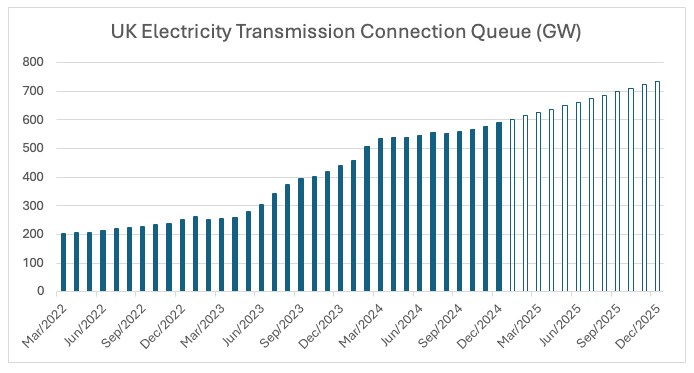
This is demonstrated by new grid connections requests, which have surged to accommodate electricity load growth across European transmission networks. In the UK, there has been a 136% increase in the size of the grid connection queue over the past two years.3 In Italy, requests from data centres alone climbed from <2GW at the end of 2021 to 50GW by mid-2025.4 This compares to the country's total generation capacity of 130GW.5
Energy transition depends as much on geography as technology. Greater flows of electricity create congestion and curtailment risks, especially in countries where resource-rich areas are far from major cities. For instance, in the UK, Italy, and Sweden, strong solar and wind resources are often located far from industrial centres. Existing grids lack capacity to efficiently transport electricity to demand centres, creating bottlenecks. This can lead to wasted energy and higher system costs. Investing in high-capacity transmission infrastructure is essential to channel renewable power from resource-abundant regions to where it’s used.
An inflection point for European grids
Europe is entering a major investment cycle in transmission and distribution (“T&D”) networks. Governments recognise that rising electricity demand is straining grids, many of which are close to saturation points for renewables. Capacity limits push up system costs which are ultimately borne by consumers. These costs include payments to stop generators, run backup plants and maintain network stability.
In the UK, doubling transmission build-out by 2030 to facilitate decarbonisation is a strategic priority.7 Ofgem estimates that investment to expand grid capacity will lower household bills by £30 by 2031, by addressing the system costs associated with curtailment and long-term reliance on gas plants.8
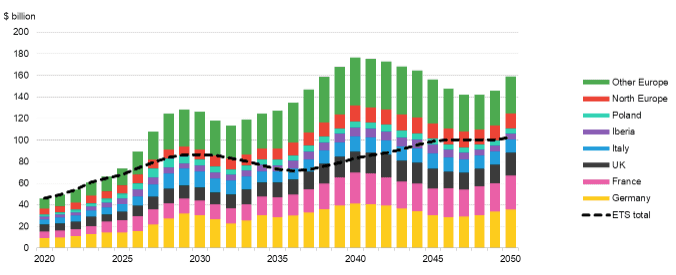
The November 2023 EU Grids Action Plan has accelerated grid development across member states.9 Utilities are rolling out projects to integrate renewables, connect data centres, and support electrification of heavy industry. Across Europe, grid capex is expected to exceed $70 billion by 2025, twice the level of a decade ago.10 These investments are driving rapid growth in the Regulated Asset Base (RAB) of utilities that own and operate the networks. This includes high-voltage transmission lines, substations, cables, and transformers that form the backbone of the power system and account for much of the capital spend.
Utilities earn government-approved rates of return on these investments, designed to ensure fair pricing for consumers while providing predictable profits for operators and investors. Because regulated returns compound on a growing asset base, grid expansion has the potential to support earnings and shareholder value over time.
Italy – a case study in transmission
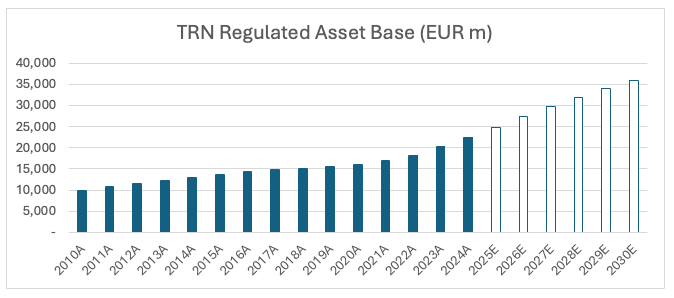
Terna (“TRN”), Italy’s national transmission operator, offers a clear case study of how transmission investment underpins both decarbonisation objectives and energy security. Italy has long relied on imported fossil fuels, especially Russian gas, which made up more than 40% of imports before 2022.12 The country now aims for 65% renewable electricity generation by 203013 and carbon neutrality by 2050.14 Rapid solar and wind growth in the south has outpaced transmission capacity, creating bottlenecks.
Terna plans to invest €18 billion between 2024 and 2028 to alleviate pressures on the grid. This represents a 65% increase on the previous regulatory period and will drive a 9% compound annual growth rate in the size of its asset base.15 This supports earnings growth as regulated utilities collect more revenues from customers as new assets are commissioned. Key future projects include the €3.7 billion Tyrrhenian Link (connecting Sicily–Sardinia–mainland), the €1.5 billion Adriatic Link (in central Italy), and the Italy–Tunisia interconnector, which will triple cross-border capacity and position Italy as a Mediterranean power hub.16
These investments aim to connect more renewable generation, ease congestion, and strengthen resilience to external energy shocks. At the same time, regulatory stability provides predictable multi-year return frameworks which give investors visibility over future earnings and dividend growth. Strategic grid investment is being deployed to develop AI infrastructure, decarbonise power generation and support energy security. Utilities like Terna are, in our view, well-set to benefit from this investment and enjoy their time in the sun.
Risk: The FP Foresight Global Real Infrastructure Fund, the FP Foresight UK Infrastructure Income Fund and the FP Foresight Sustainable Real Estate Securities Fund are Equity funds and the FP Foresight Diversified Real Assets Fund is a Multi-Asset fund. Investors should be willing and able to assume the risks of investing in these funds. The value of an investment and the income from it can fall as well as rise as a result of market and currency movement; you may not get back the amount originally invested. The Funds are actively managed with the UK CPI +3% and the FTSE EPRA NAREIT Developed Net TRI GBP used as comparator benchmarks only.
This is marketing communication. Please refer to the prospectus, supplement and KIID/KID for the funds, which contain full information on the risks and detailed information on their characteristics and objectives, before making any final investment decisions.
Disclaimer: This insight may provide information about Fund portfolios, including recent activity and performance and may contain facts relating to equity markets and our own interpretation. Any investment decision should take account of the subjectivity of the comments contained in this insight. This insight is provided for information only and all the information contained in it is believed to be reliable but may be inaccurate or incomplete; any opinions stated are honestly held at the time of writing but are not guaranteed. The contents of this insight should not therefore be relied upon. It should not be taken as a recommendation to make an investment in the Funds or to buy or sell individual securities, nor does it constitute an offer for sale.