



About impact investing
Impact investing should be accessible to everyone. Read more about what we do and how we do it.
How did impact investing arise?
The term "impact investing" was coined by the Rockefeller Foundation in 2007, but the underlying principle is older. The approach at the centre of impact investing took some time to develop because shareholder primacy, the view that shareholders' needs should be prioritised over those of the other company stakeholders, was the prevailing theory from the 1970s.
But that began to change as awareness of the climate crisis and broader social and environmental challenges grew, increasing support for sustainability and impact investing
In 2009, the Global Impact Investing Network (GIIN) was established to build and support the impact investing industry globally. Today, impact investing is a recognised and growing discipline, supported by a developing body of regulation and reporting standards. The word “impact” itself played an important role in crystallising the movement.

Impact investing and the spectrum of capital
Generic sustainability strategies
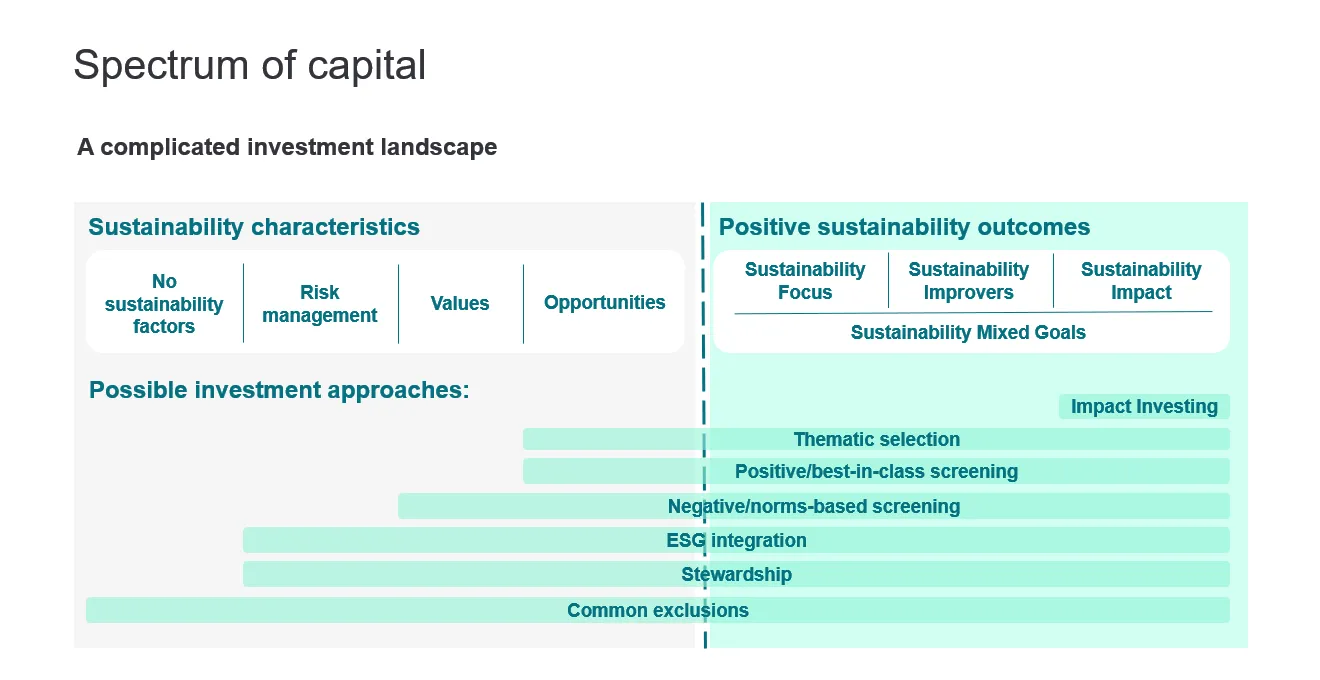
Impact investing sits within a broader spectrum of sustainability strategies that also includes ESG integration and exclusionary or inclusionary screening. The terms are often used interchangeably, but they mean quite different things.
ESG integration, the most widely used approach, incorporates environmental, social and governance data into investment analysis, often using ratings from specialist data providers. The focus is primarily on how a company operates, not what it produces. As a result, ESG-integrated portfolios can include companies from sectors such as armaments, tobacco and oil and gas, provided they score well on operational metrics relative to their peers.
Exclusionary and inclusionary screening filters investments in or out based on specific characteristics, but can still leave significant gaps where the underlying data is poorly understood or inconsistently applied.

The value of impact investing
Impact investing goes further. The starting point is what a company sells. Companies whose products or services generate negative outcomes do not qualify, regardless of how well they score operationally. The funds focus on companies providing direct solutions to environmental and social challenges. ESG factors are considered in assessing how those companies operate, but as a complement to the impact analysis, not a substitute for it.
The objective is competitive financial returns over the long term. Impact and financial return are not in tension: companies addressing the world's most significant challenges are well positioned to grow.
The spectrum of capital maps these different approaches, from traditional investing through to philanthropy, and includes the FCA's sustainability labels under the Sustainability Disclosure Requirements (SDR) regime.
Combatting 'greenwashing'
Sadly, the growth in sustainable investing has been accompanied by growth in greenwashing. This means that some investment products are marketed as sustainable without the substance to match. At its worst, greenwashing misleads investors and undermines confidence in the broader sector.
The good news is that regulation is catching up. The FCA's Sustainability Disclosure Requirements (SDR) are among a range of new standards requiring investment managers to be specific about their intentions, rigorous in their process and transparent about outcomes. For managers whose sustainability claims are not backed by evidence, this will require significant changes.
All our impact funds comply with the stronger SDR regulations, which means that our investors can have greater confidence that their money is being managed in the way it is described.
What makes our approach to impact investing distinctive?
Intentional impact investment
What sits at the core of being an impact investor? Intention. The decision to invest must be clearly based on the ‘enterprise impact’ of the business. By ‘enterprise impact’ we mean the impact delivered by the products and services the company is producing. The impact story needs to be a significant part of the investment case and we need to intend for the investment to contribute to positive impact.
We're dedicated to investing in this way. For each of our nine investment themes we've set out a ‘problem statement’ that we're trying to solve. We then set out a ‘theory of change’, a sequence of cause-and-effect actions that connect WHEB's activities with the specific positive social and environmental outcomes that we are targeting. This theory of change frames all of WHEB's investment activities.
Impact measurement
Clients and their advisers want to know that we're investing their money in a way that aligns with their values and enables positive outcomes. We embrace this deeper client interest in our portfolio companies and we've made a commitment to radical transparency in sharing information about our philosophy, policies and practices.
Investor contribution
When WHEB invests in portfolio companies, we make our own contribution to increasing positive outcomes - and this, in turn, impacts the share price. But while this investment benefits portfolio companies in multiple ways, there are two additional key areas where we make a contribution as investors.
- Enterprise level: Through stewardship activities such as engagement with companies and proxy voting at AGMs.
- Systems level: Engagements aimed at the wider financial system that indirectly support positive impact businesses.
WHEB’s contribution in these areas includes engagement downstream with regulators, policy makers and standard setters, as well as upstream back to clients and their advisers.
Our operations
The vast majority of our impact comes through the investments we make. However, as a business we also have a direct social and environmental footprint. We seek to maximise the positive impact that we have through our own operations and report on this annually.

Impact investing glossary
The terminology of sustainable investing evolves quickly and is not always used consistently. A short glossary is available to help investors navigate the key terms and distinctions.
Stay ahead of the market
Receive fund updates, insights and event invitations straight to your inbox